
A franchise waste management permit is defined as a municipal authorization granting a private hauler exclusive rights to collect and dispose of waste within a specific geographic zone. Understanding what is a franchise waste management permit matters directly to franchise business operators because it determines who collects your waste, what you must separate, and what happens when service fails. The permit is held by the hauler, not by your business. Your obligation is compliance with the hauler's service requirements and your city's diversion mandates. Operators who confuse hauler permits with individual business permits routinely face fines, missed pickups, and failed inspections.
What is a franchise waste management permit, exactly?
A franchise waste management permit is the legal instrument a city or county issues to a private waste hauler, granting that company the exclusive right to collect commercial and residential waste within a defined zone. The permit is not issued to individual businesses. It is the foundation of the municipal waste collection system, and every business operating inside a franchised zone is subject to it whether they know it or not.
The term "franchise" here carries a specific legal meaning. It refers to a contractual franchise agreement between a municipality and a private hauler, not a business franchise like a restaurant chain. This distinction trips up franchise business owners constantly. Your franchise brand agreement and your city's waste franchise agreement are entirely separate legal instruments.
Franchise business operators should understand this distinction clearly before assuming they have any choice in waste hauler selection. Within a franchised zone, you cannot switch providers. The city has already made that decision on your behalf. Knowing this upfront saves time, money, and compliance headaches. For a broader look at the permits your locations must maintain, the franchise permit types guide covers the full picture.

How do municipal franchise waste management agreements work?
Municipal waste franchise agreements grant exclusive collection rights to a private hauler for a defined geographic area, with typical contract terms of 7–10 years and franchise fees ranging from 5% to 12% of gross receipts. Those fees flow directly to the municipality. They fund public programs and regulatory oversight, not hauler profits.
The city retains authority over service levels, collection schedules, and rate structures even though a private company does the actual work. This is a critical point. The hauler operates under the city's rules, not the other way around. That means rate disputes, service failures, and compliance questions all trace back to the municipal public works department.
Franchise agreements also define exactly what waste types the hauler is authorized to collect. Specialized waste types such as medical, hazardous, and construction debris are typically excluded from franchise agreements entirely. Operators who generate those waste streams need separate permits and separate contracts. Never assume your franchise hauler covers everything leaving your loading dock.
| Agreement element | What it means for operators |
|---|---|
| Exclusive zone rights | You cannot hire a different hauler for standard waste |
| 7–10 year contract terms | Service provider is locked in for years at a time |
| 5%–12% franchise fee | Fee is built into your service rate, not billed separately |
| Municipal rate authority | City controls pricing, not the hauler |
| Excluded waste types | Hazardous and medical waste require separate handling |
Pro Tip: Check your city's public works portal to identify your exact franchise zone and authorized hauler before signing any lease for a new location. Zone boundaries do not always follow street grids.
What are the waste management permit requirements for franchise operators?
Franchise business operators carry specific compliance obligations under the waste disposal franchise system, even though they do not hold the permit themselves. The core requirement is using the designated hauler and following that hauler's service and separation protocols. Deviating from those protocols puts you in violation of the municipal franchise agreement, which carries real penalties.
Waste stream separation is the most common compliance gap. State diversion laws such as California's SB 1383 require businesses to separate trash, recyclables, and organic waste into distinct streams. Non-compliance triggers municipal enforcement actions and fines. This is not a hauler policy. It is state law enforced through the franchise system.
Franchise waste management regulation guidelines increasingly integrate organic waste diversion and recycling mandates directly into service expectations. That means your hauler's service contract will specify bin types, collection frequency, and contamination standards. Violating those standards is a compliance failure, not just a service issue.
The practical steps every franchise operator should follow:
- Confirm your franchise zone and authorized hauler with your city's public works department before opening a location.
- Request the hauler's current service agreement and read the waste separation requirements in full.
- Set up separate bins for trash, recyclables, and organics as required by local diversion mandates.
- Train staff on contamination rules. A recycling bin full of food waste is treated as trash and may trigger a fine.
- Keep records of collection dates, bin weights, and any service disruptions. Cities increasingly require this documentation during audits.
- Report service failures to the municipal public works department, not the hauler's customer service line.
Pro Tip: Request a written confirmation of your franchise zone assignment from your city's public works office. This document protects you if a hauler dispute arises and proves your compliance starting point.
What common misconceptions do franchise owners have about waste permits?
The most damaging misconception is that franchise business operators can shop around for a better hauler rate. Waste collection under franchise models is legally a "sanitary service" distinct from regulated utilities, but it functions like a monopoly within each zone. You have one hauler. Negotiating price is not an option.
Several other misconceptions cause real compliance problems:
- Businesses hold the franchise permit. They do not. The hauler holds the permit. Your obligation is compliance with the hauler's service terms and the city's diversion requirements.
- Service complaints go to the hauler. Wrong. Service quality issues must be escalated to the municipal public works department. The hauler's liability under an exclusive contract is limited, and the city is the enforcement authority.
- The franchise hauler covers all waste types. Franchise agreements specify accepted materials. Medical, hazardous, and construction waste require separate handling and separate permits.
- Franchise zones are city-wide. Most cities divide into multiple zones, each with its own authorized hauler. A franchise operator with locations in two parts of the same city may deal with two different haulers under two different service agreements.
- Permit renewals are automatic. Franchise agreements have defined terms. When a contract expires or is rebid, the authorized hauler can change. Operators need to monitor municipal announcements and adjust their service setup accordingly.
Cities like Los Angeles operate exclusive franchise zones with as many as 13,000 commercial accounts per zone. That scale illustrates why the city, not the hauler, is the right point of contact when something goes wrong.
How can franchise operators navigate the permit process effectively?
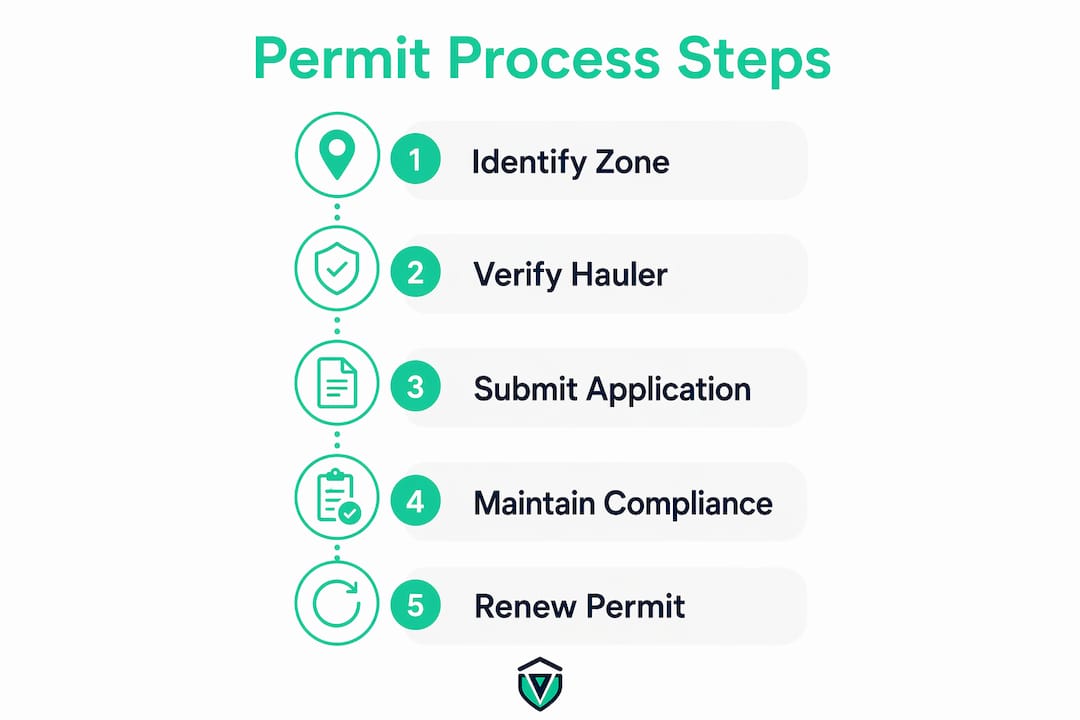
Effective navigation starts with knowing your zone. Franchise business owners should prioritize identifying their municipal franchise zone designation and authorized hauler before any other compliance step. Your city's public works portal is the authoritative source. Most cities publish zone maps, hauler contact information, and service requirement documents online.
Once you know your zone and hauler, the permit process for operators is less about filing paperwork and more about maintaining ongoing compliance. The hauler holds the permit. Your job is to meet the service conditions that permit requires. That means accurate waste separation, timely payment of service fees, and proper documentation of collection activity.
Multi-location franchise operators face an added layer of complexity. Each location may fall in a different franchise zone with different haulers, different bin requirements, and different diversion targets. Managing this manually across a portfolio of locations creates real risk of missed requirements. A territory-based permit approach helps operators organize compliance by zone rather than by location, which matches how municipal enforcement actually works.
For operators opening new locations, the franchise location permit checklist covers the full sequence of steps, including waste management compliance, before a location opens.
Key Takeaways
A franchise waste management permit is held by the authorized hauler, not the business. Operator compliance means following the hauler's service terms and the city's diversion mandates within your assigned zone.
| Point | Details |
|---|---|
| Permit holder is the hauler | Businesses comply with the permit's terms but do not hold it themselves. |
| Zones determine your hauler | Your city assigns one authorized hauler per zone. You cannot switch providers. |
| Separation mandates are law | State diversion laws like SB 1383 require trash, recyclables, and organics to be separated. |
| Service complaints go to the city | Escalate hauler failures to municipal public works, not the hauler's customer line. |
| Excluded waste needs separate permits | Medical, hazardous, and construction debris fall outside standard franchise agreements. |
Franchise waste permits function like a utility. Treat them that way.
Franchise operators spend a lot of energy negotiating with vendors. Waste management is one area where that instinct does not apply. The franchise agreement between your city and the hauler eliminates competition by design. Municipal waste franchise contracts eliminate competition to protect consistent environmental compliance and public health across zones. That is a policy choice, not an oversight.
What I have seen trip up operators repeatedly is the assumption that a service problem is a vendor problem. It is not. When your hauler misses a pickup or charges incorrectly, the city is your leverage point. Public works departments have enforcement authority over haulers. Your hauler does not have that same authority over you, but the city does. Building a relationship with your local public works contact is worth more than any rate negotiation.
The other thing operators underestimate is how fast diversion requirements are tightening. Organic waste mandates, recycling contamination rules, and reporting requirements are expanding in most states. Getting ahead of those changes, rather than reacting to enforcement notices, is the difference between a compliant operation and a costly one. Franchise waste management is not a set-it-and-forget-it compliance item. It requires active monitoring, especially as your location count grows.
— Rakin
How Vaultedai helps franchise operators stay on top of waste compliance
Tracking waste management permit requirements across multiple franchise locations is exactly the kind of problem that breaks spreadsheet-based systems. Each location may have a different zone, a different hauler, and different diversion targets. Deadlines shift when franchise agreements are rebid. Requirements change when state mandates update.
Vaultedai is built for multi-location franchise operators who need one place to centralize permits, compliance documents, and renewal deadlines across every location. The platform flags upcoming changes, organizes requirements by zone, and gives your team clear visibility into what is current and what needs attention. Operators managing five locations or fifty use Vaultedai to replace the manual tracking that leads to missed deadlines and compliance gaps. Visit Vaultedai to see how the platform fits your operation.
FAQ
What is a franchise waste management permit?
A franchise waste management permit is a municipal authorization granting a private hauler exclusive rights to collect waste within a defined geographic zone. The permit is held by the hauler, not by individual businesses operating in that zone.
Can a franchise business choose its own waste hauler?
No. Within a franchised zone, the city designates one authorized hauler. Businesses cannot opt out or hire a different provider for standard waste collection.
Who do I contact when my waste hauler misses a pickup?
Contact your city's municipal public works department, not the hauler's customer service line. The city holds enforcement authority over the hauler under the franchise agreement.
What waste types are excluded from franchise agreements?
Medical, hazardous, and construction debris are typically excluded from standard franchise agreements. These waste types require separate permits and separate handling contracts.
How long do municipal waste franchise agreements last?
Most municipal waste franchise agreements run for 7–10 years. When a contract expires or is rebid, the authorized hauler for your zone can change, so operators should monitor municipal announcements.