
Fire inspection compliance means your building meets the codes your local authority having jurisdiction (AHJ) enforces, backed by documented inspection, testing, and maintenance (ITM) records under whatever edition of NFPA and International Fire Code standards that AHJ has adopted. It is not just working equipment. It is proof, on paper, that the equipment works and gets checked on schedule.
If an inspection is on the calendar, do three things today. Check every sprinkler, alarm, and extinguisher tag for a current service date. Walk your primary egress path and confirm exit signs and emergency lighting actually illuminate. Pull your approved building plans and your fire protection contractor's license or NICET credential so you can hand them over on request.
- Verify inspection tags and service dates on all fire protection equipment
- Confirm exit routes are clear and emergency lighting functions
- Gather approved plans, acceptance tests, and technician credentials
The two names worth knowing before anything else: NFPA, which writes the technical standards, and your AHJ, the local fire marshal or department that decides which edition of those standards applies and how strictly to enforce it.
Key Takeaways
Fire inspection compliance depends on maintained records at every required interval, not just functioning equipment, and a missing tag can fail an inspection as fast as broken hardware.
| Point | Details |
|---|---|
| Compliance is documentation | Working equipment with a missing service record still fails inspection. |
| Know your AHJ's edition | NFPA sets the standard; your local AHJ decides which edition applies and how it's enforced. |
| Track device-specific cadences | Sprinklers, alarms, extinguishers, and hoods each run on different NFPA-driven schedules. |
| Preparation prevents fees | Failed inspections from poor prep can trigger hourly recovery charges like Seattle's $373 rate. |
| Centralize multi-site tracking | A single schedule with automated reminders cuts missed renewals across locations. |
Table of Contents
- What Do Fire Inspectors Actually Check?
- Which Standards Govern Fire Code Requirements?
- How Often Do Fire Systems Need Inspection?
- What Should You Have Ready Before an Inspection?
- What Happens When a Fire Inspection Fails?
- How Should You Document Fixes After an Inspection?
- How Do You Build a Compliance Program Across Multiple Sites?
- Where to Verify Fire Code and Inspection Requirements
- What Most Compliance Advice Gets Wrong
- Sources
What Do Fire Inspectors Actually Check?
Inspectors work through a building in layers, starting with how people get out and ending with how staff behave day to day.
Life safety comes first: exits, egress routes, illuminated exit signage, emergency lighting, and posted occupant loads. Passive fire protection covers the stuff that contains a fire before anyone reacts: fire-rated doors, dampers, rated walls, and sealed penetrations where cables or pipes pass through. Active systems get the closest scrutiny: sprinklers, standpipes, fire pumps, and the alarm control panel with its initiating devices.
Then come portable and special systems:
- Fire extinguishers, checked for current tags and accessible mounting
- Kitchen hood suppression systems, especially in food service
- Hazardous material storage controls and clearances
Finally, inspectors ask about operations, not just hardware: hot work permits, current evacuation plans, and records showing staff have actually trained on them. A building can have perfect equipment and still fail if nobody can produce a drill log.
Which Standards Govern Fire Code Requirements?
Five NFPA standards do most of the heavy lifting in a typical commercial inspection:
- NFPA 10 — portable fire extinguishers
- NFPA 25 — inspection, testing, and maintenance of water-based systems like sprinklers
- NFPA 72 — fire alarm and signaling systems
- NFPA 96 — kitchen exhaust and suppression systems
- NFPA 101 — the Life Safety Code, covering egress and occupant protection
Most jurisdictions layer these on top of the International Fire Code as their baseline. Here's the part that trips up multi-site operators: NFPA writes technical guidance, but it has no enforcement power on its own. Your AHJ decides which edition to adopt, how to interpret gray areas, and how aggressively to enforce it. A sprinkler clearance that passes in one county can fail two towns over under an older or newer code cycle.
Report format matters too. Technicians need NICET certification or a state license depending on the trade, and healthcare facilities often need reports formatted to Joint Commission or DNV standards, not just a generic service ticket.
Pro Tip: Call your local fire marshal's office and ask which code edition is currently adopted. It's a five-minute call that can save you from failing an inspection over a standard you followed correctly, just not the right version.
How Often Do Fire Systems Need Inspection?
Every system runs on its own clock, and missing one link in that chain is one of the most common reasons a functioning system still fails inspection.
- Sprinkler systems (NFPA 25): Quarterly checks on visible components, annual main drain and alarm tests, plus five-year internal pipe inspections and ten-year tasks like valve overhauls.
- Fire alarms (NFPA 72): Monthly or quarterly device testing depending on grouping strategy, semiannual battery checks on control equipment, and a full annual system test covering every initiating and notification device.
- Portable extinguishers (NFPA 10): Monthly visual checks confirming pressure and accessibility, annual maintenance by a certified technician, and internal or hydrostatic testing every 5 to 12 years depending on extinguisher type.
- Kitchen hood suppression (NFPA 96): Semiannual professional service and cleaning, more often in high-volume kitchens.
- Fire pumps, emergency power, and standpipes: Weekly or monthly churn tests for pumps, annual flow tests, and periodic standpipe hydrostatic testing.
The NFPA 25 cadence alone involves at least three different frequencies for one system. Multiply that across sprinklers, alarms, extinguishers, and hoods at even a single site, and you're tracking a dozen overlapping schedules by hand.
What Should You Have Ready Before an Inspection?
Preparation determines outcome more than equipment quality does. Work through this the day before and the morning of your inspection:
- Documents: Approved plans or as-builts, acceptance test records, current inspection tags on every device, and technician licenses or certifications.
- Physical checks: Clear exit paths with nothing stored in front of doors, an unobstructed fire department connection (FDC), roughly 30 inches of clearance around electrical panels, and 18 to 24 inches between stored materials and sprinkler heads, though exact figures can vary by AHJ.
- Operational readiness: A trained staff member available to walk the inspector through the building, any pre-testing already completed, and certified contractors on-site if system testing is part of the visit.
Skipping this step has a real price tag. Seattle Fire Department charges a $373 per hour failed-inspection recovery fee when a lack of contractor or owner preparation causes the failure, covering prep time, travel, and the on-site visit itself.
Pro Tip: Do a mock walkthrough using the inspector's own checklist logic: exits, panels, tags, storage clearances. Most failures come from the same five or six items every time.
What Happens When a Fire Inspection Fails?
The same violations show up on nearly every failed report: blocked exits, expired or missing inspection tags, storage crammed too close to sprinkler heads, blocked electrical panels, and extension cords used as permanent wiring. Orlando's Business Fire Safety Checklist flags nearly all of these as the most common correctable items.
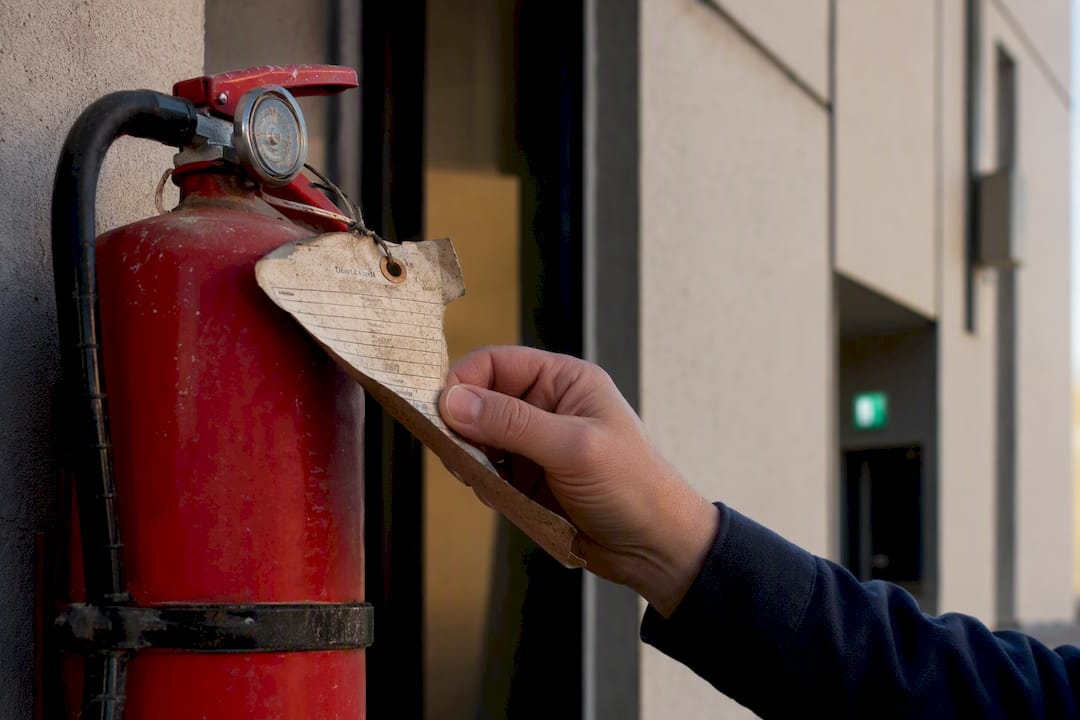
Outcomes escalate based on severity. Minor issues usually get a correction notice with a deadline. Miss that window and you're paying re-inspection fees, sometimes on top of the $373 hourly rate Seattle charges for preventable failures. Serious violations, especially blocked egress, can trigger fines or an immediate shutdown order.
Insurance carriers pay attention too. A failed inspection or a lapse in documented ITM can trigger premium increases, non-renewal, or a denied claim if a fire happens while your systems were technically out of compliance.
How Should You Document Fixes After an Inspection?
Fixing a violation and proving you fixed it are two separate jobs, and skipping the second one leaves you exposed at the next visit.
- Take timestamped photos of every correction, before and after
- Keep work orders, parts receipts, and updated service tags together in one file
- Retain records for 3 to 7 years, longer in healthcare settings where regulatory retention rules run longer
- Respond to deficiency notices in writing, referencing the specific corrective action taken
- Attach the technician's credentials to the resubmitted report; missing credentials are a routine cause of report rejection
An organized paper trail also does something less obvious: it shortens your next inspection, because the inspector can see a maintained history instead of starting from scratch.
How Do You Build a Compliance Program Across Multiple Sites?
One building is manageable with a binder and a wall calendar. Ten buildings across five AHJs is a different problem entirely, and it's where most compliance programs actually break down.
A working program needs five pieces: a map of which code edition each AHJ has adopted, one centralized inspection schedule instead of site-by-site spreadsheets, a credential tracker for every technician and contractor, a document repository for tags and acceptance tests, and automated reminders before deadlines hit rather than after.
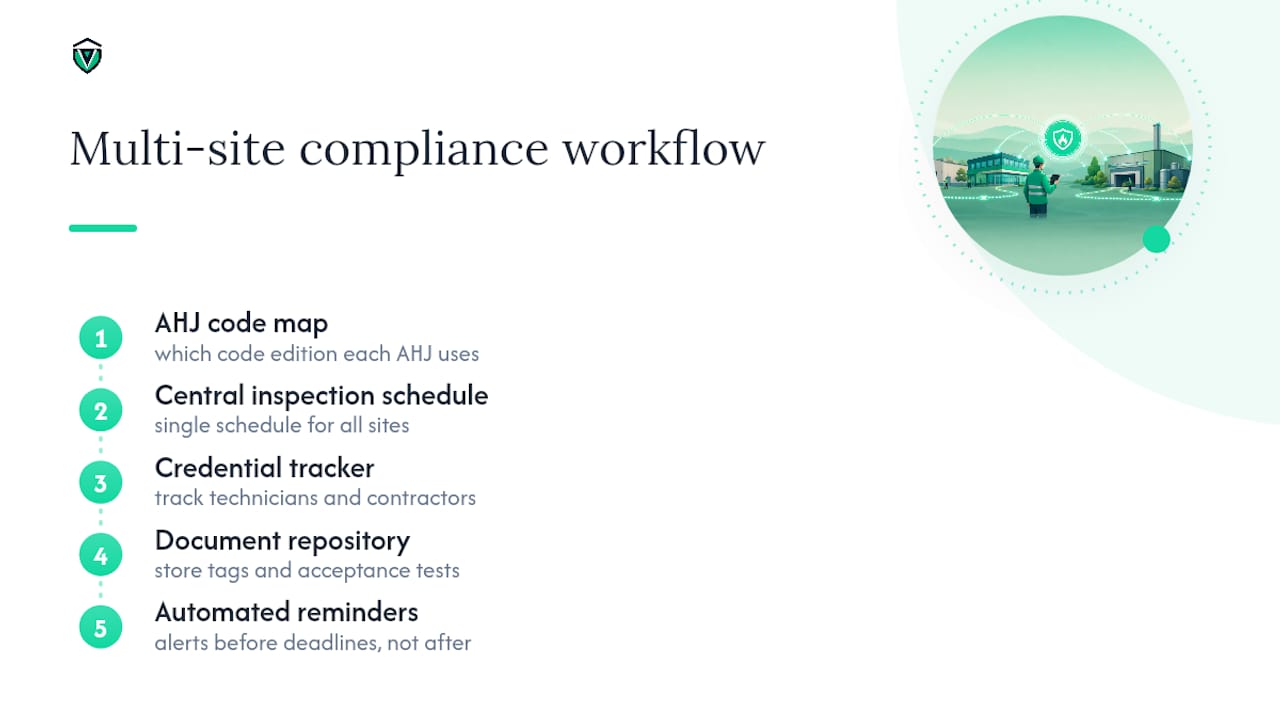
Centralizing permits and inspection tags is what actually prevents the missed renewal that turns into a failed inspection and a recovery fee. When you're rolling this out, prioritize your highest-risk sites first, import existing inspection history rather than starting fresh, and assign a local owner at each location who's accountable for that site's readiness.
This is the exact gap Vaulted was built to close for multi-location operators managing permits and renewals across dozens of jurisdictions at once. You can see how that plays out in practice through Vaulted's case studies.
Pro Tip: Start your AHJ map with the sites that have failed an inspection in the last two years. That's where a repeatable process pays for itself fastest.
Where to Verify Fire Code and Inspection Requirements
Confirm technical language and local procedure directly at the source before you act on it:
- NFPA 10: Portable Fire Extinguishers
- NFPA 25: Water-Based Fire Protection Systems
- NFPA 72: National Fire Alarm and Signaling Code
- Seattle Fire Department: Engineering Inspection Process (CAM5966)
- City of Orlando: Business Fire Safety Checklist
- OSHA: Fire Safety Standards
What Most Compliance Advice Gets Wrong
Most guidance on this topic treats fire inspection like a one-time event you pass or fail. That framing misses the actual mechanic behind most failures: a broken chain of records over time, not a single bad decision. A sprinkler system can be mechanically flawless and still fail inspection because nobody logged last quarter's test.
The conventional advice, "know your local codes," is true and mostly useless on its own. The real skill is treating every AHJ relationship as its own small research project, because two buildings ten miles apart can be held to different code editions with different enforcement habits.
If you manage more than one location, the priority isn't buying more fire extinguishers or memorizing NFPA numbers. It's building one system that tells you, at a glance, which site is due for what test and whether the last one actually got documented. Multi-site operators who treat that as a spreadsheet problem eventually lose track. Those who treat it as an operational system, mapped by AHJ, tracked by device, backed by evidence, are the ones who stop paying re-inspection fees.
Sources
- Seattle Fire Department — CAM5966: The Engineering Inspection Process (October 2025)
- NFPA — NFPA 25: Standard for the Inspection, Testing, and Maintenance of Water-Based Fire Protection Systems
- NFPA — NFPA 72: National Fire Alarm and Signaling Code
- NFPA — NFPA 10: Standard for Portable Fire Extinguishers
- City of Orlando — Business Fire Safety Checklist