

For multi-location operators, the recommended approach to asbestos removal certification management is a single centralized, auditable repository with automated renewal workflows, jurisdiction-aware templates, and chain-of-custody tracking. Spreadsheets and paper binders fail this test every time an unannounced inspector arrives.
Here is what that architecture delivers:
- Regulatory compliance: OSHA's long-term retention requirement for personal air sampling records means your document lifecycle must outlast most software contracts. Build retention into the system, not the filing cabinet.
- Regulator-ready exports: EPA and NESHAP require notifications, clearance certificates, and waste manifests to be producible quickly. A centralized system generates board-ready PDFs and chain-of-custody histories on demand.
- Missed expiration prevention: Automated 60/30-day alerts on contractor licenses and project notifications eliminate the manual calendar-checking that lets credentials lapse unnoticed.
- Vaultedai maps directly to this architecture: centralized register, metadata templates, automated alerts, and fast onboarding for multi-site portfolios.
Key Takeaways
Managing asbestos removal certification across multiple locations requires a centralized, auditable repository with automated renewal workflows, enforced metadata, and chain-of-custody tracking tied to OSHA's 30-year retention anchor.
| Point | Details |
|---|---|
| Centralize the register | Build one portfolio-wide repository with consistent fields; scattered folders and paper binders fail regulator requests. |
| Automate renewal alerts | Configure 60/30-day expiration alerts with escalation paths so no contractor license or accreditation lapses unnoticed. |
| Require digital close-out packets | Every project must produce a complete, signed packet before payment releases and before the record is archived. |
| Assign one owner per site | A named accountable owner per location prevents management plans from drifting out of date across the portfolio. |
| Vaultedai for multi-site portfolios | Vaultedai provides centralized register, automated alerts, board-ready exports, and guided onboarding for multi-location operators. |
Table of Contents
- What does "asbestos removal certification" mean for compliance teams?
- Who legally holds responsibility for retaining certifications?
- Key regulatory retention periods and notification rules you must plan for
- Minimum metadata and naming conventions every certificate should carry
- How to centralize asbestos removal certificates across multiple locations
- Designing automated renewal and expiry workflows for asbestos removal certifications
- What should you evaluate in a compliance platform for this?
- What to require from contractors and red flags that should pause payment
- Typical implementation phases and cost drivers
- How a multi-location operator centralized asbestos removal certificates
- The compliance officer's perspective on what actually matters
- Vaultedai centralizes and automates asbestos removal certification management
- Primary sources and guidance referenced
- Sources
What does "asbestos removal certification" mean for compliance teams?
The phrase covers the full set of documented proof that a regulated abatement project was performed legally and safely. It is not a single certificate. For compliance purposes, every project close-out packet should contain:
- Contractor/company license: Current state-issued asbestos contractor license, including license number and expiration date.
- Worker and supervisor accreditations: Individual handler and supervisor credentials tied to the specific project record.
- Pre-notification to regulators: NESHAP requires written notification well in advance of regulated renovation or demolition before regulated renovation or demolition, including owner details, project schedule, estimated ACM quantity, waste transporter, and project supervisor.
- Air sampling and clearance results: Personal exposure monitoring data and post-abatement clearance air test results signed by an accredited industrial hygienist.
- Waste manifests with chain-of-custody: Signed copies confirming disposal at a licensed facility, with manifest return tracked and confirmed.
- Daily enclosure and pressure logs: Signed records confirming negative pressure was maintained throughout the project.
- Post-abatement clearance certificate: The final sign-off document confirming the area is safe for reoccupancy.
EPA's recordkeeping guidance specifies that permanent files should include inspection reports, O&M program plans, work procedures, respirator procedures, fiber release reports, work approvals, and reinspection records.
| Document type | Must-have metadata | Who signs | Retention trigger |
|---|---|---|---|
| Contractor license | License number, state, expiration date | Licensing authority | Project start date |
| Pre-notification | Project ID, ACM quantity, schedule, disposal site | Owner/operator | Notification submission date |
| Air sampling results | Sample dates, monitor ID, lab accreditation | Industrial hygienist | Project close date |
| Waste manifest | Manifest ID, transporter, disposal facility | Contractor + facility | Manifest return date |
| Clearance certificate | Project ID, location ID, signer credentials | Accredited hygienist | Project close date |
Who legally holds responsibility for retaining certifications?
The dutyholder principle is clear: responsibility for managing and retaining asbestos records stays with the person in control of the premises. Hiring a licensed contractor or a third-party consultant does not transfer that duty. If the contractor's records are lost or incomplete, the liability lands on the building owner or operator.
Practically, this means the dutyholder must maintain:
- On-site copies of the current contractor license and worker accreditations for any active project.
- Corporate central copies of all project notifications, clearance certificates, and waste manifests.
- Surveillance and reinspection records that confirm the O&M program is active.
EPA's O&M guidance reinforces this: written program elements must be available to O&M staff and occupants, not locked in a contractor's filing system.
Pro Tip: Add a contract clause requiring the contractor to upload the complete close-out packet to your designated repository within five business days of project completion, and tie final payment release to verified upload. This creates a documented handoff and preserves your audit trail regardless of contractor turnover.
Key regulatory retention periods and notification rules you must plan for
OSHA requires personal air sampling records to be retained for at least 30 years and medical records for employees in medical surveillance programs for the duration of employment plus 30 years. Plan your document lifecycle accordingly.
That 30-year anchor is the hardest planning constraint most operators underestimate. A project completed today needs its records accessible in 2056. State regulations add their own layers: Delaware's asbestos certification program, for example, sets 30-year minimum retention requirements at the contractor level alongside defined renewal timelines. Design your retention policy to meet the longest applicable period across your jurisdiction mix.
Key notification and retention triggers to calendarize:
- NESHAP pre-notification: 10 working days before any regulated renovation or demolition.
- OSHA air sampling records: 30-year minimum from the date of the record.
- OSHA medical surveillance records: Duration of employment plus 30 years.
- State/local contractor license renewals: Varies by state; typically annual or biennial.
- O&M reinspection cycles: Typically annual, but confirm with local authority.
- Waste manifest returns: Track and confirm return within the expected window; flag overdue returns immediately.
Minimum metadata and naming conventions every certificate should carry
Consistent metadata is what turns a folder of PDFs into a searchable, auditable record set. Every certificate and project document should carry these fields at minimum:
- Location ID (unique identifier tied to your portfolio register)
- Building footprint or room ID
- Project ID (links all documents for a single abatement project)
- Scope summary (material type, quantity, abatement method)
- Contractor name and license/certification number
- Air monitor ID and accreditation number
- Sample dates and clearance date
- Disposal manifest ID
- Signer name, credential, and signature date
- Retention end date (calculated from the applicable retention trigger)
A consistent naming convention — for example, [LocationID]_[ProjectID]_[DocType]_[YYYYMMDD] — makes bulk searches and regulator responses fast. Acorn's multi-site playbook recommends consistent fields across the portfolio register, including condition, risk score, last inspection, next inspection due, and accountable person.
Pro Tip: Build a mandatory "project close" checklist that automatically routes completed packets into the long-term retention bucket and flags any missing documents before the project is marked closed. No packet, no close.
How to centralize asbestos removal certificates across multiple locations
A single canonical repository per portfolio is the architecture that scales. Every location links to the same system; records are never siloed by site or region.
Core architecture requirements:
- Role-based access: Field staff see their site's records; regional managers see their cluster; board reviewers get read-only portfolio dashboards. No one has more access than their role requires.
- Encryption at rest and in transit: Required for any document containing worker health data or personally identifiable information.
- Immutable audit logs: Every document upload, edit, download, and deletion is timestamped and attributed. This is the chain-of-custody record for your records.
- Versioning: When a contractor license is renewed, the old version is retained (not overwritten) with its original effective dates.
- Long-term retention policies: Automated archiving rules enforce the 30-year OSHA anchor without manual intervention.
Governance controls that prevent drift:
- One named accountable owner per site, responsible for completeness and currency of that site's records.
- Automated reconciliation tasks that flag sites with missing documents or overdue inspections.
- On-site confirmation documents (current contractor license, active project notification) available for inspectors without requiring a call to corporate.
Designing automated renewal and expiry workflows for asbestos removal certifications
Automation removes the human dependency from renewal tracking. A well-designed workflow covers these events:
- Expiration triggers: Contractor license expiration, worker accreditation expiration, O&M reinspection due date.
- NESHAP windows: Pre-notification deadlines calculated backward from scheduled project start dates.
- Project close triggers: Checklist completion required before a project record is archived.
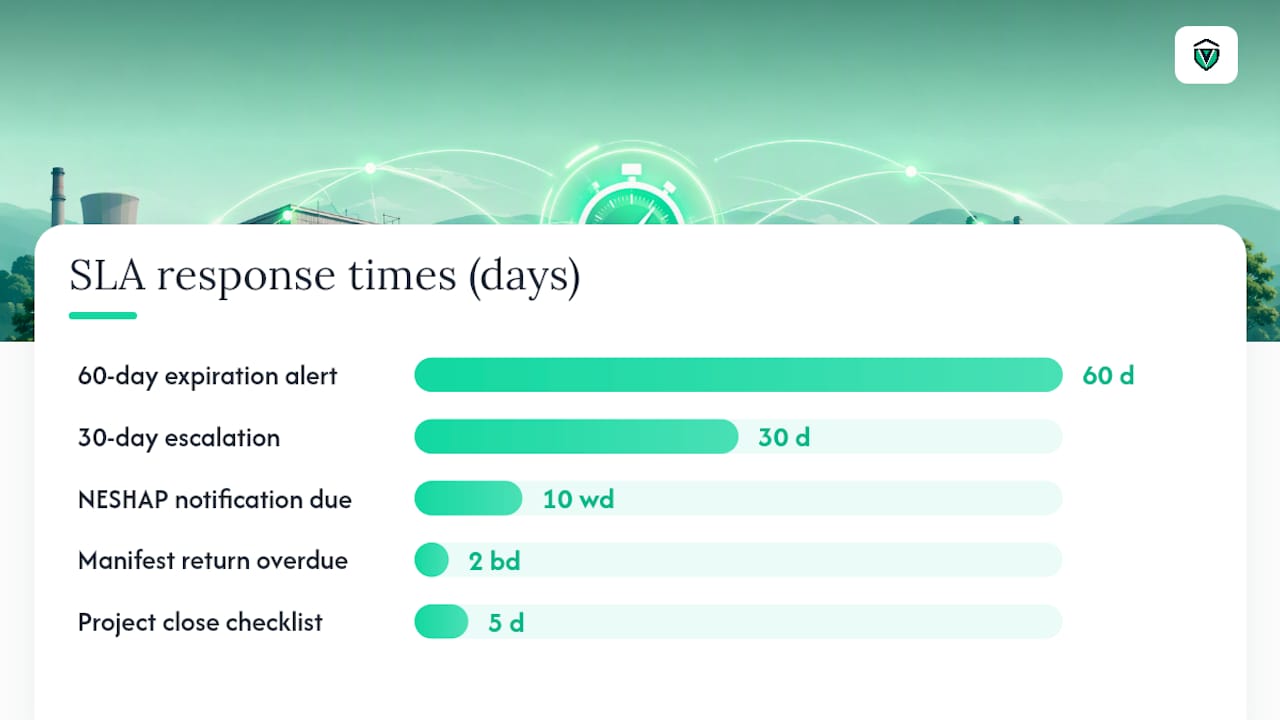
| Workflow event | Owner | SLA | Audit artifact |
|---|---|---|---|
| 60-day expiration alert | Site compliance owner | Acknowledge within 3 days | Alert sent + acknowledged log |
| 30-day escalation | Regional manager | Renewal initiated or waiver documented | Escalation record |
| NESHAP notification due | Project manager | Submitted 10 working days before start | Notification copy + submission timestamp |
| Manifest return overdue | Site compliance owner | Follow-up within 2 business days | Follow-up log + resolved date |
| Project close checklist | Site compliance owner | Complete within 5 days of project end | Signed close-out packet |
Integrations that make this work: HR systems for credentialing data, SSO for access control, work-order systems for permit-to-work linkage, and e-signature tools for chain-of-custody sign-offs.
What should you evaluate in a compliance platform for this?
| Dimension | Entry-level field apps | Enterprise platforms |
|---|---|---|
| Document storage & metadata | Basic file upload, limited fields | Structured metadata templates, required fields enforced |
| Automated renewal workflows | Manual reminders only | Configurable cadence, escalation paths, audit trail |
| Jurisdiction-specific checklists | Generic templates | State/local checklist libraries, updated for regulatory changes |
| Audit/export capabilities | CSV export | Board-ready PDFs, chain-of-custody histories, regulator packages |
| Security & access controls | Password protection | Role-based access, encryption, SOC 2, immutable audit logs |
| Integrations | None or limited | HR, SSO, work-order, e-signature |
| Onboarding speed | Self-serve, days | Guided onboarding, professional services available |
| Pricing model | Per-user flat | Per-location or tiered by portfolio size |
Demo scenarios to require: upload a project close-out packet and verify all metadata fields are enforced; trigger a 30-day expiration alert and trace the escalation path; export a board-ready PDF for a single site and for the full portfolio; request SOC 2 Type II report and encryption documentation.
For accreditation and EPA Model Accreditation Plan context, confirm the platform supports the credential types your jurisdiction requires.
What to require from contractors and red flags that should pause payment
Required documentation from every contractor before work begins and at project close:
- Current state asbestos contractor license (verified against the issuing authority's database)
- Worker and supervisor accreditations tied to the project record
- Air monitor certificates and lab accreditation numbers
- Signed daily enclosure and negative-pressure logs
- Waste manifest copies with chain-of-custody, including transporter and disposal facility details
Red flags that should trigger a hold:
- Expired or missing contractor license or worker accreditations
- Incomplete or unsigned waste manifests
- Gaps in enclosure pressure logs
- Late or absent clearance air test results
- Inconsistent sample chain-of-custody (lab receipt date before sample date, missing signatures)
Pro Tip: Automate the payment hold-release: configure your system to block final payment approval until the close-out packet is uploaded, all required fields are populated, and a compliance owner has verified the checklist. Manual verification without a system lock is a gap that gets skipped under deadline pressure.
Typical implementation phases and cost drivers
A phased rollout controls risk and accelerates time-to-value:
- Discovery and register build (weeks 1–4): Audit existing records, identify gaps, and build the portfolio register with consistent fields per the Acorn single-register model.
- Template and workflow configuration (weeks 3–6): Configure metadata templates, retention rules, and automated alert cadences for your jurisdiction mix.
- Pilot rollout (weeks 5–8): Deploy to 3–5 sites. Validate templates, test escalation paths, and confirm regulator-ready export formats.
- Full rollout (weeks 8–16 for portfolios under 50 sites; 16–24 weeks for larger portfolios): Migrate legacy files, train site owners, and activate automated workflows.
- Post-rollout audit (30 days after go-live): Confirm all sites have current surveys, zero open close-out packets, and all alerts are firing correctly.
Primary cost drivers: number of sites, legacy file hygiene (the messier the paper trail, the longer the migration), number of jurisdictions requiring custom checklists, and whether professional services are needed for data migration or survey coordination. Quick win: start the pilot with your highest-risk sites, not the easiest ones.
How a multi-location operator centralized asbestos removal certificates
A restaurant group operating 40 locations across three states had asbestos records spread across on-site paper binders, a shared drive with inconsistent folder structures, and a contractor's own filing system. When a state inspector requested project notifications and clearance certificates for two locations within 24 hours, the compliance team spent most of that window locating documents rather than reviewing them.

The approach: build a single portfolio register using consistent fields, run a rolling survey to confirm current condition ratings at all 40 sites, and configure automated alerts for contractor license expirations and O&M reinspection due dates.
KPIs tracked post-rollout:
- Percentage of sites with a current management survey on file (target: 100%)
- On-time renewal rate for contractor licenses and worker accreditations
- Average age of open close-out packets (target: under 5 days)
- Time to produce a regulator-ready export (target: under 15 minutes)
To replicate: you need one compliance owner to lead the register build, a template for the minimum metadata schema, and a platform that enforces required fields on upload. Go-live checklist: portfolio register complete, all active project notifications uploaded, automated alerts configured, and at least one board-ready export tested.
The compliance officer's perspective on what actually matters
The conventional wisdom in asbestos compliance is that the hard part is the survey and the abatement. The actual hard part is what happens after: keeping 40 or 400 management plans current, ensuring every contractor's license is valid before work starts, and being able to produce a complete chain-of-custody for any project within an hour of an inspector's call.
Most programs fail not because the abatement was done wrong, but because the records were never centralized. A paper binder at the site is not a compliance program. A shared drive with inconsistent folder names is not either. The board-level governance practices that protect organizations require documented, auditable evidence, not good intentions.
Three things that actually move the needle: name one accountable owner per site (not a team, one person), require a digitally signed close-out packet for every project before payment releases, and treat your management plan as a live document with a calendar-based review date. Everything else is downstream of those three.
Vaultedai centralizes and automates asbestos removal certification management
Multi-location operators who have outgrown spreadsheets get a direct path to compliance with Vaultedai: a centralized register across all locations, metadata templates that enforce required fields on every upload, and automated 60/30-day alerts that escalate to regional managers when site owners don't respond.
Chain-of-custody document flows, board-ready PDF exports, and immutable audit logs are built in, not bolted on. Integrations with HR systems, SSO providers, and work-order platforms mean your credentialing data and permit-to-work workflows stay connected. Onboarding is guided, not self-serve: Vaultedai's team works with you through the pilot phase so your templates and escalation paths are validated before full rollout.
Start with a demo. Bring your current portfolio size and your messiest jurisdiction, and see how fast the register build takes.
Primary sources and guidance referenced
Key regulatory and operational sources used throughout this guide:
- OSHA 29 CFR 1910.1020: The federal standard governing access to employee exposure and medical records, including the 30-year retention requirement for personal air sampling records.
- EPA O&M Program Guidance: Defines what an O&M program must include (training, work practices, surveillance) and the availability requirements for written program elements.
- EPA Recordkeeping for O&M Plans: Enumerates the core documents that must be retained permanently in an asbestos management program file.
- EPA Information for Building Owners and Managers: Covers NESHAP notification requirements, AHERA MAP accreditation expectations, and regulated-work thresholds.
- Delaware Asbestos Certification and Training Program: Example of state-level certification rules, including 30-year contractor retention requirements and renewal timelines.
- Acorn Analytical Services Multi-Site Playbook: Practical guidance on single consolidated registers, rolling survey programs, and accountable owner structures for large portfolios.
This article is general information, not a substitute for advice from a qualified lawyer. Consult a qualified legal professional about your own circumstances before acting on anything here.
Sources
- 29 CFR 1910.1020 - Access to employee exposure and medical records | Occupational Safety and Health Administration
- What is an operations and maintenance (O&M) program? | US EPA
- Recordkeeping for asbestos operation and management (O&M) plans | US EPA
- Multi Site Asbestos Compliance: A Practical Playbook For Property Managers - Acorn Analytical Services