
A commercial kitchen permit is a public-health authorization confirming that your food facility meets local sanitation, safety, and operational standards required to legally serve food to the public. Issued by local or county health departments, this permit is not optional. Every restaurant, catering operation, food truck commissary, and shared kitchen must hold one before opening. The kitchen licensing process varies by jurisdiction, but the core requirement is universal: your facility must pass plan review and inspection before you can legally operate. Understanding what this permit covers, what it costs, and how it fits into your broader licensing stack is the first step toward opening without delays.
What is a commercial kitchen permit and how does it work?
A commercial kitchen permit is the formal document a health department issues after verifying that your kitchen meets food safety and sanitation codes. In Virginia, for example, a food establishment permit is issued only after plan review and inspection confirm compliance with state food regulations. This means the permit is not a formality. It is the health department's documented confirmation that your facility is safe to operate.
The permit process functions as a risk-management tool. Health departments use it to verify that handwashing stations are correctly placed, food storage meets temperature and separation requirements, and sanitation flows prevent cross-contamination before a single customer is served. The permit is tied to a specific physical address, which means it does not transfer if you move locations or change your food operation type without notifying the department.

Permit fees vary widely. Virginia charges a $40 plan review fee, while larger jurisdictions like Boston note that plan review and inspections can take several months from submission to approval. Budget for both the time and the cost before you sign a lease.
How to get a kitchen permit: steps and requirements
The kitchen permit requirements follow a predictable sequence across most U.S. jurisdictions, though the specific documents and fees differ by city and county.
-
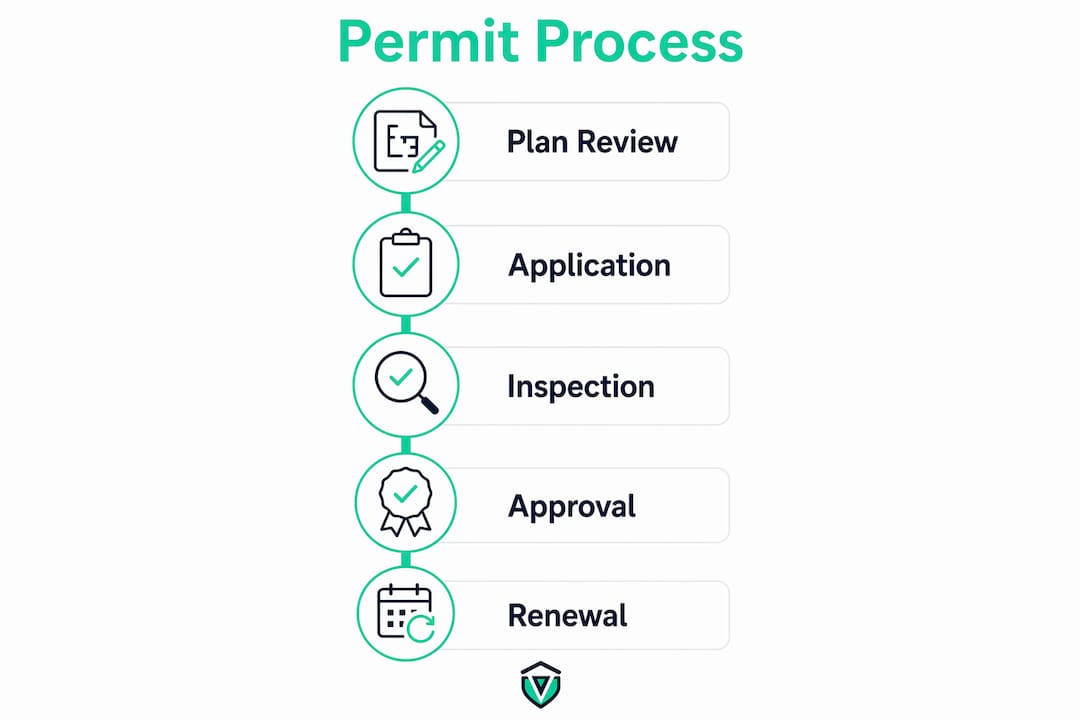
Submit your plans for review. Before construction or remodeling begins, you submit architectural and equipment layout plans to the health department. Inspectors use these plans to set expectations for the final inspection. Any changes made after plan approval can trigger a new review cycle and delay your opening.
-
Pay the application and plan review fees. Fees are typically paid at submission. Virginia requires the $40 plan review fee upfront, while larger cities charge several hundred dollars depending on facility size and operation type.
-
Complete construction or setup. Build or outfit your kitchen exactly as approved in the plan review. Deviating from approved plans is one of the most common and costly mistakes new operators make.
-
Schedule and pass the pre-opening inspection. An inspector visits the facility to verify that handwashing stations, food storage areas, ventilation, and sanitation systems match the approved plans. Inspectors also check that equipment meets NSF International standards and that temperature controls are functional.
-
Receive your food service permit. Once the inspection passes, the health department issues the commercial kitchen license. You cannot legally serve food until this document is in hand.
Pro Tip: Submit your plan review application at least 30 to 60 days before your target opening date. Boston's permitting office notes that the review and inspection cycle alone can take several months, and that timeline does not include time to fix deficiencies.
For a broader look at how health department permits fit together, the types of health department permits guide covers sequencing and requirements across permit categories.
How do shared and commissary kitchen permits differ?
Shared kitchens and commissary kitchens operate under a different permit structure than single-operator food businesses, and this distinction trips up a significant number of new food entrepreneurs.
| Permit type | Who holds it | What it covers |
|---|---|---|
| Commercial Commissary Kitchen permit | The kitchen operator or owner | Authorizes the facility to host other food businesses |
| Food establishment permit (tenant) | Each individual food business using the kitchen | Authorizes that specific business to prepare and sell food |
| Standard food service permit | Single-operator restaurant or kitchen | Covers one business at one fixed location |
King County, Washington makes this structure explicit. The Commercial Commissary Kitchen permit allows the kitchen operator to host other food businesses, but each tenant must hold a separate operating permit. The kitchen operator's permit does not extend to the tenants. This is a common misunderstanding: food entrepreneurs who rent time in a shared kitchen often assume the facility's permit covers their operation. It does not.
Chicago follows a similar model, with distinct permit classes for shared kitchen operators and the individual cottage food or catering businesses that use them. The practical implication is that if you plan to operate out of a commissary or shared kitchen, you need your own food establishment permit in addition to confirming that the kitchen's operator permit explicitly covers your food operation type.
Pro Tip: Before signing a shared kitchen rental agreement, ask the operator to show you their permit and confirm in writing that your specific food operation type is covered under their facility's authorization. Then apply for your own tenant permit immediately.
For more on the legal distinctions between kitchen operators and tenants, the commercial lease permit guide explains shared-use arrangements in detail.
What additional licenses and certifications come with a commercial kitchen permit?
The commercial kitchen permit is one piece of a larger compliance stack. Local authorities typically require multiple distinct permits and certifications before you can legally serve food, and the order in which you apply matters.
-
Business license or Common Victualler License. Boston requires operators to obtain a Common Victualler License before receiving a Food Service Health Permit. Applying in the wrong order delays your opening because the health permit application cannot be processed without the business license already in place.
-
Certificate of Occupancy. Boston's Food Service Permit documentation requires a Certificate of Occupancy, confirming that the building itself is legally approved for its intended use. Structural and legal compliance must precede health permit approval.
-
Food protection manager certificate. Most jurisdictions require at least one certified food protection manager on staff. This is a separate credential from the facility permit, typically earned through programs like ServSafe or the National Registry of Food Safety Professionals.
-
Allergen awareness certificate. Several states and cities now require food handlers to complete allergen training. Massachusetts, for example, mandates allergen awareness certification for food service workers.
-
Proof of insurance and signed affidavits. Boston requires signed affidavits and insurance documentation as part of the food service permit application package.
-
Ongoing food handler certifications. Hamilton, Ontario mandates that certified food handlers be present during all operating hours. Many U.S. jurisdictions have equivalent requirements, meaning compliance is not a one-time event at opening.
Understanding the difference between a building permit and a health permit is also critical. A building permit authorizes construction. A health permit authorizes food service. Both are required, and neither substitutes for the other. The building permit guide explains this distinction clearly for operators setting up new facilities.
What are the most common pitfalls when applying for a kitchen permit?
Most permit delays are avoidable. The operators who open on time are the ones who treat the permitting process as a project with dependencies, not a checklist to complete at the last minute.
The single biggest mistake is submitting plans late or making changes after plan approval. Plan approval sets the inspection standard. If you move a handwashing sink or swap out a piece of equipment after the plans are approved, the inspector will flag the discrepancy and you will need a new review cycle before the permit is issued.
The second most common mistake is confusing a building permit with a food safety permit. Operators who receive their Certificate of Occupancy sometimes assume they are cleared to open. They are not. The health department inspection is a separate process with separate requirements, and it must be completed and passed before the food service permit is issued.
A third pitfall specific to shared kitchen users is assuming the facility's permit covers their operation. As King County's commissary permit structure shows, tenants need separate permits regardless of the host kitchen's authorization. Operating without your own permit in a shared kitchen is a compliance violation, even if the kitchen itself is fully licensed.
Pro Tip: Create a permit dependency map before you start the application process. List every license and certification required in your jurisdiction, identify which ones must be obtained before others, and work backward from your target opening date. Boston's licensing sequencing rules are a good example of why order matters.
For a detailed breakdown of retail food permit requirements, the retail food permit guide covers local licensing procedures relevant to food businesses at every stage.
You should also maintain records of all food handler certifications, inspection reports, and renewal dates after you open. Health departments conduct routine inspections after the initial permit is issued, and missing a renewal or failing to have certified staff on site can result in fines or temporary closure.
Key takeaways
A commercial kitchen permit is the legal foundation of every food business. Without it, no other investment in your operation matters.
| Point | Details |
|---|---|
| Permit is location-specific | A commercial kitchen permit is tied to a specific address and operation type, not the business owner. |
| Plan review sets inspection standards | Submit plans early and never deviate from approved layouts without notifying the health department. |
| Shared kitchens require two permits | The kitchen operator holds one permit; each tenant food business must hold a separate operating permit. |
| Licensing order matters | Applying for permits out of sequence, as Boston's rules illustrate, can delay your opening by weeks or months. |
| Compliance is ongoing | Food handler certifications, routine inspections, and renewal deadlines continue after the initial permit is issued. |
The permit process rewards operators who treat it as infrastructure
Most food entrepreneurs I have worked with treat the permit process as a bureaucratic hurdle to clear once and forget. That framing causes real problems. The operators who open on time and stay open without interruption are the ones who treat their permits and certifications as living infrastructure, not a one-time paperwork exercise.
The plan review stage is where I have seen the most preventable damage. Operators rush through it, submit incomplete drawings, or make equipment changes after approval without notifying the health department. Each of those decisions adds weeks to the timeline and real dollars to the budget. The plan review is not a formality. It is the document that tells the inspector exactly what to look for on opening day. Treat it accordingly.
The shared kitchen permit issue is the other area where I consistently see confusion. Food entrepreneurs who rent commissary space often believe the kitchen's license covers them. It does not, and operating under that assumption is a compliance risk that can result in fines or forced closure. King County's commissary permit structure makes this explicit, but many operators only discover the gap after an inspector shows up.
My honest advice: engage your local health department early, before you sign a lease or finalize your equipment list. Most health departments will do a pre-application meeting at no cost, and that conversation can save you months of rework. The permit process is not designed to stop you from opening. It is designed to confirm you are ready to do so safely.
— Rakin
How Vaultedai helps you stay on top of permit compliance
Managing a commercial kitchen permit is straightforward when you have one location. It gets complicated fast when you are operating multiple kitchens, managing renewal deadlines across jurisdictions, or onboarding new locations on a rolling basis. Vaultedai is built for exactly that situation. The platform centralizes all your permits, licenses, food handler certifications, and renewal deadlines in one place, so nothing falls through the cracks as you scale.
Restaurant operators and food service groups use Vaultedai's permit tracker to replace manual spreadsheets with automated deadline alerts, document storage, and compliance visibility across every location. If you are managing more than one kitchen or planning to grow, Vaultedai gives you the operational clarity to stay compliant without the administrative overhead.
FAQ
What is a commercial kitchen permit?
A commercial kitchen permit is a public-health authorization issued by a local health department confirming that a food facility meets sanitation, safety, and operational standards required to legally serve food. It is tied to a specific address and operation type.
How long does it take to get a kitchen permit?
The timeline varies by jurisdiction. Virginia requires plan submission at least 30 days before opening, while Boston notes the review and inspection process can take several months. Plan for at least 60 to 90 days from plan submission to permit issuance.
Do I need my own permit if I use a shared or commissary kitchen?
Yes. The kitchen operator's permit covers the facility, not the individual food businesses using it. King County's commissary permit structure confirms that each tenant must hold a separate operating permit regardless of the host kitchen's authorization.
What is the difference between a building permit and a food service permit?
A building permit authorizes construction or renovation of a physical space. A food service permit authorizes the preparation and sale of food from that space. Both are required to open a food business, and the Certificate of Occupancy from the building permit process must typically be obtained before the health department will issue the food service permit.
What happens if I operate without a commercial kitchen permit?
Operating without a valid food service permit exposes your business to fines, forced closure, and potential legal liability. Health departments conduct routine inspections after opening, and an expired or missing permit can result in immediate shutdown orders.